Pain Studies Lab members are studying how the form of a chronic pain story shapes the way readers respond to it. The study, “Do ‘You’ Feel More Connected When Directly Addressed? Investigating Second-Person Self-Address in Chronic Pain Narratives,” asks whether a story feels different when it is written like a letter. This work builds on InterLeaf, a reflective mobile app concept designed to support people living with chronic pain through letter writing, reflection, and peer connection.
Many digital health tools focus on tracking symptoms, routines, or treatment goals. This study looks at a different part of chronic pain support: how people share their experiences, and how others respond when they read them. Chronic pain is often hard to explain, and many people living with it describe feeling unseen or misunderstood.
In the study, readers see short fictional chronic pain stories in two formats. One version is written as a self-addressed letter, where the writer speaks to themselves or their body using “you.” The other version is written as a first-person post, where the writer describes the same experience using “I.” After reading each story, participants answer questions about how they experienced it. The study looks at whether the story made them feel empathy for the writer, whether the writer seemed relatable, and whether they felt a sense of connection with the person behind the story.
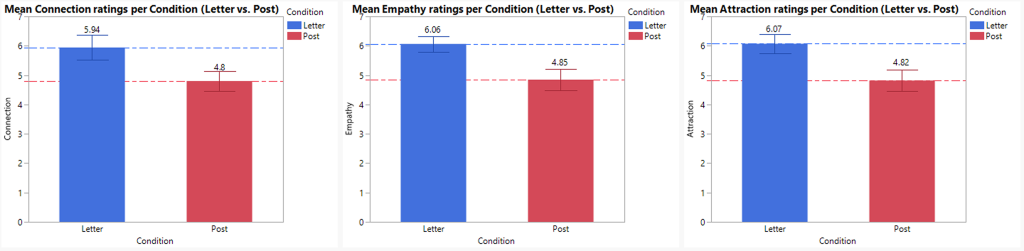
The following figure summarizes the overall mean ratings by condition for (a) felt connection, (b) empathy, and (c) social attraction. Across all three outcomes, participants responded more positively to the second-person self-addressed letter format than to the matched first-person post format.
 The goal is to better understand how small design choices, such as writing prompts or narrative format, can shape connection in digital health and peer-support systems. For projects like InterLeaf, this matters because the aim is not only to help people write about pain, but also to create conditions where those stories can be received with care.
A presentation video for the study is available here:
Watch the presentation video
You can participate in the study here:
View the study page
