Category

Uncategorized

How Narrative Perspective Shapes Connection in Chronic Pain Stories

By | Uncategorized

Pain Studies Lab members are studying how the form of a chronic pain story shapes the way readers respond to it. The study, “Do ‘You’ Feel More Connected When Directly Addressed? Investigating Second-Person Self-Address in Chronic Pain Narratives,” asks whether a story feels different when it is written like a letter. This work builds on InterLeaf, a reflective mobile app concept designed to support people living with chronic pain through letter writing, reflection, and peer connection.

Many digital health tools focus on tracking symptoms, routines, or treatment goals. This study looks at a different part of chronic pain support: how people share their experiences, and how others respond when they read them. Chronic pain is often hard to explain, and many people living with it describe feeling unseen or misunderstood.

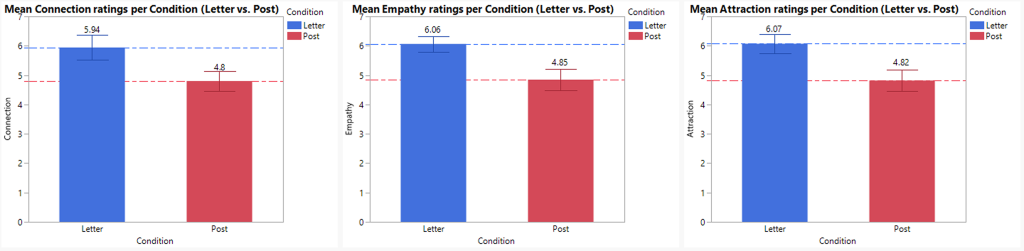
In the study, readers see short fictional chronic pain stories in two formats. One version is written as a self-addressed letter, where the writer speaks to themselves or their body using “you.” The other version is written as a first-person post, where the writer describes the same experience using “I.” After reading each story, participants answer questions about how they experienced it. The study looks at whether the story made them feel empathy for the writer, whether the writer seemed relatable, and whether they felt a sense of connection with the person behind the story.

The goal is to better understand how small design choices, such as writing prompts or narrative format, can shape connection in digital health and peer-support systems. For projects like InterLeaf, this matters because the aim is not only to help people write about pain, but also to create conditions where those stories can be received with care.
A presentation video for the study is available here:
Watch the presentation video

You can participate in the study here:
View the study page

InterLeaf Poster Accepted to CHI26

By | Uncategorized

Pain Studies Lab’s InterLeaf: A Letter-Based Mobile Platform for Reflection, Connection, and Chronic Pain Support has been accepted to the poster track at CHI EA ’26: Extended Abstracts of the 2026 CHI Conference on Human Factors in Computing Systems.

InterLeaf is a mobile platform designed to support people living with chronic pain through reflective letter writing, comfort-item sharing, and intentional peer connection. The extended abstract responds to a gap in many digital health tools, which often focus on symptom tracking and behaviour monitoring while offering limited space for reflection, emotional expression, or meaningful connection.

The platform includes three main features: private or anonymously shared letters, a communal Grove of Solace for sharing meaningful comfort objects, and asynchronous chats that begin when users feel a strong connection with another person’s story.

The extended abstract also presents an AI tagging pipeline that identifies themes in user narratives, including symptoms, emotions, triggers, coping strategies, and body areas. In an offline evaluation using 250 synthetic letters, the system showed promise for cautious safety screening and interpretable tagging, while highlighting the need for confidence-aware design and user-editable tags.

Read more here.

Video: Watch the InterLeaf video

Paper: InterLeaf: A Letter-Based Mobile Platform for Reflection, Connection, and Chronic Pain Support
Conference: CHI EA ’26: Extended Abstracts of the 2026 CHI Conference on Human Factors in Computing Systems
DOI: 10.1145/3772363.3798739
Authors: Sara Khalilipicha, Armin Froozanfar, Diane Gromala, Chris Shaw, Philippe Pasquier, Patricia Derbyshire

New Research & Thinking from the Pain Studies Lab…

By | Uncategorized
I am pleased to announce the completion of two recent works that offer crucial insights into survivance, equity, and trauma-wise care. A key focus of this research is how Indigenous cultural continuity and reimagined human-computer interaction can transform health technologies to better mitigate both immediate trauma impacts and the long-term physiological consequences, such as chronic pain, experienced by sexual assault survivors.

1. Bridging the Gap: Geography, Justice, and Sexual Assault Care
I’m thrilled to present the Report to Community from research co-created with the incredible team at She Matters. This project directly addresses the challenge of getting timely, trauma-wise care and services to survivors of sexual assault in northern and remote communities. We went directly to survivors and care providers in remote regions to hear their lived experiences and decision processes when seeking post-assault care.
  • Key Focus: We explored the critical interactions that could improve support, access to forensic evidence collection, and—most importantly—how to offer culturally relevant care that enhances immediate and longer-term healing pathways.
  • Why This Matters Now: The report tackles a critical gap, particularly for Indigenous women, who experience disproportionately high rates of sexual violence and face systemic barriers within the Canadian healthcare system.
Citation:
May-Derbyshire, P., & She Matters. (2025). Does geography impact access to justice—Research findings. She Matters. https://www.shematters.ca/does-geography-impact-access-to-justice

2.  Rethinking Technology: From Human-Computer Interaction to Kinship

I’ve also recently published a chapter that fundamentally challenges how we think about the relationship between people and technology. Kitot’sattook: Indigitalized spaces, Time Travel and Kinship Computing Interconnection (KCI), appears in the book Future Spaces of Power.
  • The Decolonial Shift (KCI): In direct contrast, I introduce Kinship Computing Interconnection (KCI)—a powerful decolonizing framework. This framework is enriched by Blackfoot teachings (nitsitapissini) and centers concepts like kitot′sattook (intimate relationship with kin) and saaponsstaa (magical, mysterious experiencing).

  • The Goal: KCI is a transformative approach that rejects the field’s historical complicity in cultural erasure. It proposes moving beyond human-computer interaction to Indigitalized interconnection, where technology is designed around kinship, animacy, and relational ethics to nurture youth well-being and community healing.
I hope this chapter contributes to a fundamental shift in how we can use digital spaces for healing and connection.
Citation:
May-Derbyshire, P. (2026). Kitot’sattook: Indigitalized spaces, time travel and Kinship Computing Interconnection (KCI). In C. Alphin, E. L. McKagen, & S. E. Ward (Eds.), Future spaces of power: The cultural politics of digital and outer spaces (pp. 181–204). Bloomsbury Publishing.

I’m excited for the conversations these two pieces will spark, both here at the SFU Pain Lab and Indigitalized discussions beyond!
(Patti Derbyshire, MA, M.Ed, PhD Student)

AI-Powered VR for Chronic Pain: Pain Studies Lab at PervasiveHealth 2025

By | Uncategorized

Sara Khalilipicha recently presented our latest work at the 19th EAI International Conference on Pervasive Computing Technologies for Healthcare (PervasiveHealth 2025) held in Eindhoven, the Netherlands, October 15–17, 2025.

Her talk, “Designing VR for Chronic Pain: Transforming AI-Powered Biofeedback to Interoceptive Awareness and Neuromodulation,” showcased how the Pain Studies Lab is rethinking VR for chronic pain beyond simple distraction.

Instead of using VR just to “take patients’ minds off the pain,” the project builds on our long-term work with the Virtual Meditative Walk (VMW): a foggy forest VR environment designed for mindfulness-based stress reduction. In VMW, patients’ physiological signals drive changes in the environment. As stress rises, fog thickens; as they relax and regulate their breathing, the fog begins to clear and ambient sounds become more present, supporting interoceptive awareness and a sense of agency over their own nervous system.

In this new work, Sara presented an AI-powered biofeedback pipeline that uses Electrodermal Activity (EDA) and Heart Rate Variability (HRV) to detect stress and emotional states far more accurately than our earlier, rule-based method in VMW. Trained on the WESAD dataset, the Extra Trees classifier achieved about 98.7% accuracy for multiclass emotion detection and 99.3% accuracy for binary stress detection, compared with roughly 76% accuracy for the original slope-based biofeedback method. This means the system can now adapt the VR environment much more precisely to users’ changing psychophysiological states, tightening the link between biofeedback, interoceptive awareness, and neuromodulation in chronic pain interventions.

The work is co-authored with Diane Gromala, Armin Froozanfar, Chris Shaw, Patti Derbyshire, and Efe Erhan, and continues the Pain Studies Lab’s research agenda on immersive, AI-supported interventions for chronic pain.

You can watch the recording of Sara’s PervasiveHealth presentation here:
Video of the presentation